This could be hit or miss, but it has Matt Damon in it. Emily Blunt can be a good actress, so I'm optimistic. It's up to the writers with this one I think.

I have finally found copy-pastable stars for movie reviews and such!
Thank you Thoughts of a madman!
★ ★ ★ ★
Thank you Thoughts of a madman!
Okay so for anatomy our assignment is to take some online tests and find out which side of the brain we use the most, print it out and write some about it. That's not a big deal, it was kind of fun. I found out I am pretty right side dominant so I read up some more on it. Come to find out that people who have right side dominant brains have deep feelings, learn by using their hands and are good with people. This is some information from About.com specifically for students.
Characteristics of Right-Brain Students
Characteristics of Left Brain Students
I have been taking anatomy this summer so that I will have a better chance of getting into nursing school. After reading this though, it seems that right sided people are doomed to be artsy while left sided people are going to achieve what I want a lot easier. Oy! I just want to help people people! Enough of this, I'm off to try and learn concepts that left sided people will learn easier than me...

Characteristics of Right-Brain Students
* You take notes but lose them. You may have a hard time keeping track of your research
* You might have a hard time making up your mind
* You are good with people
* You don't fall for practical jokes as easily as some
* You seem dreamy, but you're really deep in thought
* People may have told you you're psychic
* You like to write fiction, draw, or play music
* You might be athletic
* You like mystery stories
* You take time to ponder and you think there are two sides to every story
* You may lose track of time
* You are spontaneous
* You’re fun and witty
* You may find it hard to follow verbal directions
* You are unpredictable
* You get lost
* You are emotional
* You don't like reading directions
* You may listen to music while studying
* You read lying down
* You may be interested in “the unexplained”
* You are philosophical
Your Classes
* In history class, you enjoy the social aspects most. You like to explore the effects of things that happened in history. You like the essays, too.
* You can do well in math class if you apply yourself, but you get bored doing long problems.
* Science? Boring.
* You do well in English class, especially when it comes to reading literature and writing essays about books. You also do well in creative writing assignments.
Advice for Right Brain Students
* Choose to do personal essays
* Watch your daydreaming—keep it under control
* Let your imagination work for you in the arts
* Let your intuition work for you in social situations
* Let your deep thinking work for you during essay tests—but don’t ponder too long
* Be creative with essays. You can use colorful language well
* Use images and charts when you study
* Write down directions
* Try to be more organized!
* Don’t be overly suspicious of others
* Make outlines to organize your thoughts.
* Choose fiction in reading assignments
* Try to avoid teachers who lecture a lot; choose teachers who use activities
* You tell stories well, so write some!
* Put information into categories for better understanding
* Avoid getting bogged down by thinking of all possibilities when answering questions
* Finish things! You have so much talent, but you don’t always complete things.
You have great instincts and survival skills. If you study hard, you might be a finalist on Survivor one day!
Characteristics of Left Brain Students
* You probably work with a To-Do listCheck out the Left Right Brain Quiz
* You like to be the critic in class
* You're good at math or science
* You are rational and logical
* Your research is precise and well-documented
* You set goals for yourself
* You can interpret information well
* Your room is orderly
* You can answer questions spontaneously
* You follow directions and you do read directions (unlike some people)
* You aren't touchy-feely
* You can listen to a long lecture without losing patience
* You don’t let feelings get in your way
* You like action movies
* You read sitting up
* Your words are precise
Your Classes
* In history class, you are able to remember dates and processes.
* In math class, you enjoy going through a long calculation.
* You like the order of science.
* In English class, you have a good understanding of grammar and sentence structure.
Advice for Left Brain Students
* Study in a quiet room
* You can do math but get impatient trying to explain it to someone who struggles—so don’t volunteer to be a tutor unless you know you have the patience
* You like to lead in a study group, so go ahead and volunteer
* Join a debate team or academic competition
* Try to excel at the science fair. You can be a winner
* Take advantage of your skills in math and science
* Choose non-fiction reading
* You prefer factual questions and assignments, as opposed to open-ended questions
* You can organize your notes well, so you should
* Keep your room organized
* Don’t argue with the teacher too much
* Choose to do analytical essays
* Work alone when you have a choice. You get frustrated with others who “clown around”
* Avoid “free thinking” teachers if they confuse you
* Take more risks. Don’t be afraid to be creative
I have been taking anatomy this summer so that I will have a better chance of getting into nursing school. After reading this though, it seems that right sided people are doomed to be artsy while left sided people are going to achieve what I want a lot easier. Oy! I just want to help people people! Enough of this, I'm off to try and learn concepts that left sided people will learn easier than me...

Ick, formatting did not work on this one.
Overview of the Nervous System
* Body must communicate on a cellular level
o Nervous system and endocrine system
Functions of the Nervous System
* Receive information about changes inside and outside the body
* Process this information and determine appropriate response
* Issue commands to cells to carry out the response
Hierarchical Organization of the Nervous System
* Central Nervous System
o Brain
o Spinal cord
* Peripheral Nervous System
o Sensory (afferent) division
+ Visceral sensory division
+ Somatic sensory division
o Motor (efferent) division
+ Visceral motor division (autonomic nervous system)
# Sympathetic division
# Parasympathetic division
+ Somatic motor division
Neurons
* Functional unit of the nervous system
* Properties
o Excitability
o Conductivity
o Secretion of neurotransmitters
* Functional classes of neurons
o Sensory (afferent) neurons
o Interneurons (association neurons)
o Motor (efferent) neurons
Structure of a Typical Neuron
* Soma
o Organelles
o Neurofibrils
o Nissl bodies
o Inclusions (lipofuscin)
* Dendrites
* Axon
o Axon hillock
o Collaterals
o Axoplasm and axolemma
o Terminal arborization
+ Synpatic knobs
Overview of the Nervous System
* Body must communicate on a cellular level
o Nervous system and endocrine system
Functions of the Nervous System
* Receive information about changes inside and outside the body
* Process this information and determine appropriate response
* Issue commands to cells to carry out the response
Hierarchical Organization of the Nervous System
* Central Nervous System
o Brain
o Spinal cord
* Peripheral Nervous System
o Sensory (afferent) division
+ Visceral sensory division
+ Somatic sensory division
o Motor (efferent) division
+ Visceral motor division (autonomic nervous system)
# Sympathetic division
# Parasympathetic division
+ Somatic motor division
Neurons
* Functional unit of the nervous system
* Properties
o Excitability
o Conductivity
o Secretion of neurotransmitters
* Functional classes of neurons
o Sensory (afferent) neurons
o Interneurons (association neurons)
o Motor (efferent) neurons
Structure of a Typical Neuron
* Soma
o Organelles
o Neurofibrils
o Nissl bodies
o Inclusions (lipofuscin)
* Dendrites
* Axon
o Axon hillock
o Collaterals
o Axoplasm and axolemma
o Terminal arborization
+ Synpatic knobs
Found these over at cinemablend.com
These are the most recent shots of 'The Last Airbender' to come out.


I am looking forward to seeing this; I'm watching the cartoon right now. I can't go in with high expectations though, being such a big fan of the cartoon the movie would have to be perfect in every way for me to be completely satisfied.
These are the most recent shots of 'The Last Airbender' to come out.


I am looking forward to seeing this; I'm watching the cartoon right now. I can't go in with high expectations though, being such a big fan of the cartoon the movie would have to be perfect in every way for me to be completely satisfied.
Synopsis: The film is set in a fantasy world where the four elements of earth, air, water, and fire can be controlled through martial arts called bending, and the ruthless flame-manipulating Fire Nation is waging war to control the other nations of the world. At the same time a young boy named Aang, the last surviving wind manipulator or Airbender and is also the Avatar, the physical incarnation of the world itself who possesses the ability to manipulate all four elements, is on a quest to stop the Firebenders and save the world, with his friends Katara, a water-manipulating Waterbender from the South Pole, and her brother Sokka. But the skilled and vicious Prince Zuko, the banished Prince of the Fire Nation, is on the trail of the Avatar, seeking to regain his lost honor by capturing him.
Cytology is the study of cells
The Cell Theory:
All organisms are composed of cells
Cells are smallest physiological unit
Organism activity is based on cellular activity
Cells come only from preexisting cells
All cells have similar molecular characteristics
Cell Shapes and Sizes:
Squamous - fried egg shape
Cuboidal
Columnar
Polygonal
Stellate - star shaped
Spheroid/ovoid
Discoid
Fusiform
Fibrous
Basal - bottom, 'basement'
Apical - top, surface
Cells measured in micrometers - RBC's are 7-8 micrometers
The Outer-Cellular Components:
ICF - intracellular fluid
ECF - extracellular fluid
The Plasma Membrane:
Holds material in and out of cell
Many physiological functions
Fluid mosaic model - varied, nothing is solid
Phospholipid bilayer - fat w/ a phosphate attached
Hydrophilic heads
Hydrophilic tails
Cholesterol - makes hormones
Glycolipids - combination of sugar and fat
Membrane Proteins:
Integral proteins - pass all the way through membrane
Peripheral proteins - only found on either side
Functions:
Receptors - allows chemicals in/out
Enzymes - proteins, speed up cells
Channels - passageway from ICF to ECF
Cell identity markers - peripheral in ECF
CAMS - cell adhesion molecules, keeps things in place
Carriers - integral proteins (specific channels)
Membrane transport - how material gets back and forth through membrane
Outside the Cell Membrane:
The Glycocalyx - slim layer, ID's cell, keeps in place
Glycolipids and glycolipids
Functions - enables movement
Cellular Extensions:
Microvilli - smallest
Cilia
Flagellum - largest
Intercellular junctions:
keeps cells together
Tight junctions - share a membrane (fence)
Desmosomes - peripheral, snap connection/velcro
Gap junctions - integral, direct communication
Cytoplasm:
Cytoskeleton - structure of cell, allows movement in cell
Micro filaments
Intermediate filaments
Microtubules
Organelles
The Nucleus - boss
Nuclear envelope and pores, chromatin, nucleoplasm,
Endoplasmic Reticulum - production facilities
Rough - produces proteins
Smooth - produces lipids and carbohydrates
Ribosomes - make protein out of amino acids
Free - mobile in ICF
Fixed - attached
Golgi Complex - packaging, addresses proteins
Lysosomes - gets rid of waste, 'stomach of the cell'
Peroxisomes - gets rid of H2O2 and alcohol specifically
Mitochondria - powerplant, convert to ATP
Crista (folds) - double membrane, inner, large surface area
Matrix - fluid in mitochondria
Centrioles - expansion devices, makes new cells (divides)
Inclusions - storage sheds after product is made
Cytosol - ICF (potassium)
Fluid different in chemical composition than ECF (sodium)
The Cell Theory:
All organisms are composed of cells
Cells are smallest physiological unit
Organism activity is based on cellular activity
Cells come only from preexisting cells
All cells have similar molecular characteristics
Cell Shapes and Sizes:
Squamous - fried egg shape
Cuboidal
Columnar
Polygonal
Stellate - star shaped
Spheroid/ovoid
Discoid
Fusiform
Fibrous
Basal - bottom, 'basement'
Apical - top, surface
Cells measured in micrometers - RBC's are 7-8 micrometers
The Outer-Cellular Components:
ICF - intracellular fluid
ECF - extracellular fluid
The Plasma Membrane:
Holds material in and out of cell
Many physiological functions
Fluid mosaic model - varied, nothing is solid
Phospholipid bilayer - fat w/ a phosphate attached
Hydrophilic heads
Hydrophilic tails
Cholesterol - makes hormones
Glycolipids - combination of sugar and fat
Membrane Proteins:
Integral proteins - pass all the way through membrane
Peripheral proteins - only found on either side
Functions:
Receptors - allows chemicals in/out
Enzymes - proteins, speed up cells
Channels - passageway from ICF to ECF
Cell identity markers - peripheral in ECF
CAMS - cell adhesion molecules, keeps things in place
Carriers - integral proteins (specific channels)
Membrane transport - how material gets back and forth through membrane
Outside the Cell Membrane:
The Glycocalyx - slim layer, ID's cell, keeps in place
Glycolipids and glycolipids
Functions - enables movement
Cellular Extensions:
Microvilli - smallest
Cilia
Flagellum - largest
Intercellular junctions:
keeps cells together
Tight junctions - share a membrane (fence)
Desmosomes - peripheral, snap connection/velcro
Gap junctions - integral, direct communication
Cytoplasm:
Micro filaments
Intermediate filaments
Microtubules
The Nucleus - boss
Nuclear envelope and pores, chromatin, nucleoplasm,
Endoplasmic Reticulum - production facilities
Rough - produces proteins
Smooth - produces lipids and carbohydrates
Ribosomes - make protein out of amino acids
Free - mobile in ICF
Fixed - attached
Golgi Complex - packaging, addresses proteins
Lysosomes - gets rid of waste, 'stomach of the cell'
Peroxisomes - gets rid of H2O2 and alcohol specifically
Mitochondria - powerplant, convert to ATP
Crista (folds) - double membrane, inner, large surface area
Matrix - fluid in mitochondria
Centrioles - expansion devices, makes new cells (divides)
Inclusions - storage sheds after product is made
Fluid different in chemical composition than ECF (sodium)
Articulations - any place two bones 'meet'
Arthrology is the study of articulations
Classification of Joints:
Joints are named for bones involved
Classification based on anatomical arrangement of two bones and range of motion
3 Physiological Classes:
Immovable
Slightly movable
Freely movable
4 Anatomical Classes:
Bony
Also called synostoses
Immovable
Two bones ossified together ex: epiphyseal line in an adult
Fibrous
Also called synarthroses
Two bones bound by collagen fibers
3 subclasses:
Sutures - collagen fibers are short (between flat bones and skull)
Gomphoses - immovable collagen fibers (between teeth and mandible, maxilla)
Peridontal ligament
Syndesmoses - slightly movable, joined by long fibers (tibia to fibula, radius to ulna)
Interosseous membrane
Cartilaginous
Also called ampirthroses
Two bones bound by cartilage
All semi-movable
2 subclasses:
Synchondroses - bound by hyaline cartilage (epiphyseal plate in child)
Synphysis - bound by fibrocartilage (intervertebral discs)
Synovial
Also called diarthroses
Mostly freely movable
General Anatomy:
Articular cartilage (line capsule)
Articular cavity and synovial fluid (knee, shoulder)
Articulate capsule (surround epiphyses of bones)
Accessory Structure:
Menisci - pad of fibrocartilage
Tendons - muscle to bone
Ligaments - bone to bone, extrinsic or intrinsic
Bursae - packet of synovial fluid
Classes of Synovial Joints:
Based on patterns of movement
Monaxial
Biaxial
Multiaxial
Hinge joints - monaxial - two flat surfaces (elbow)
Gliding joints - limited monaxial - both faces smooth (carpals)
Pivot joints - monaxial - rotational (C1-C2)
Saddle joints - biaxial - linear angular (twiddle thumb)
Condyloid joints - biaxial - (carpals)
Ball and Socket joints - multiaxial (shoulders, hips)
What limits ROM?
Structure and action of muscles
Structure of articular surface of bones
Strength and tautness of ligaments, tendons, and joint capsules
Arthrology is the study of articulations
Classification of Joints:
Joints are named for bones involved
Classification based on anatomical arrangement of two bones and range of motion
3 Physiological Classes:
Immovable
Slightly movable
Freely movable
4 Anatomical Classes:
Bony
Also called synostoses
Immovable
Two bones ossified together ex: epiphyseal line in an adult
Fibrous
Also called synarthroses
Two bones bound by collagen fibers
3 subclasses:
Sutures - collagen fibers are short (between flat bones and skull)
Gomphoses - immovable collagen fibers (between teeth and mandible, maxilla)
Peridontal ligament
Syndesmoses - slightly movable, joined by long fibers (tibia to fibula, radius to ulna)
Interosseous membrane
Cartilaginous
Also called ampirthroses
Two bones bound by cartilage
All semi-movable
2 subclasses:
Synchondroses - bound by hyaline cartilage (epiphyseal plate in child)
Synphysis - bound by fibrocartilage (intervertebral discs)
Synovial
Also called diarthroses
Mostly freely movable
General Anatomy:
Articular cartilage (line capsule)
Articular cavity and synovial fluid (knee, shoulder)
Articulate capsule (surround epiphyses of bones)
Accessory Structure:
Menisci - pad of fibrocartilage
Tendons - muscle to bone
Ligaments - bone to bone, extrinsic or intrinsic
Bursae - packet of synovial fluid
Classes of Synovial Joints:
Based on patterns of movement
Monaxial
Biaxial
Multiaxial
What limits ROM?
Structure and action of muscles
Structure of articular surface of bones
Strength and tautness of ligaments, tendons, and joint capsules
Myology is the study of the muscles
There are 3 different types of muscles
Skeletal Muscle -

Voluntary
Striated
Skeletal muscle fiber is also a skeletal muscle cell
85% is fiber, 15% striated
Only in heart (duh)
Involuntary
Striated
Made of cardiocytes - fusiform shaped
Involuntary
Nonstriated - cytoskeletal is not striped
Made of fusiform cells called myocytes
There are 3 different types of muscles
Skeletal Muscle -

Cardiac Muscle -

Smooth Muscle -

Functions of Muscle:
Movement - can contract and change
Stability - keeps the bones together
Communication - facial expressions (smile, speak)
Control of body openings - voluntary
Heat production - keep body 98.6 degrees, muscle contractions (shiver - skeletal muscle)
Properties of Muscle:
Excitability - can work with electrical signals
Conductivity - can conduct electricity
Contractibility - ability to shorten
Extensibility - some ability to stretch
Elasticity - ability to return to original state
General Anatomy of Skeletal Muscles:
Made of muscle fibers, connective tissue, nervous tissue, and blood vessels.
Connective tissues:
Endomysium - single layer collagen that surrounds the inside like a cell wall
Perimysium and fascicles - end of each muscle cell, divided by perimysium
Epimysium - holds all the fascicles together in a muscle
Deep fascia
Superficial fascia - hypodermis
Fascicles and Muscle Shapes:
Determines strength and direction of tension
Fusiform muscles - fascicles nonparallel
-Biceps brachii
-Gastrocnemious
Parallel muscles
-Rectus abdominus
-Sartorius (allows us to cross our legs)
Convergent muscles
-Pectoralis major
Pennate muscles
-Unipennate (semimembraneous)
-Bipennate (rectus femoris)
-Multipennate (deltoid)
Circular muscles
-Orbicularis oris
Straight from the most legit form of Hobbit news (theonering.net) :
Guillermo Del Toro departs “The Hobbit”
PJ (Peter Jackson) ‘may direct The Hobbit’

It's a bummer that del Toro won't be directing but I can see why he would leave. It's MGM's fault that production is taking so long to get started and he has other things to do. If PJ were to direct all us LotR fans would get our wishes granted. He is guaranteed to do a dedicated job and of course knows what he is doing. But it seems that he will be forced to direct it at this point which could turn out to be a bad thing rather than good. There is a lot of money at stake and I hope that creativity is not sacrificed for dollars.
Guillermo Del Toro departs “The Hobbit”
Guillermo Del Toro announced today that he is no longer directing the two movies based on J.R.R Tolkien’s “The Hobbit”, but will continue to co-write the screenplays.
"In light of ongoing delays in the setting of a start date for filming “The Hobbit,” I am faced with the hardest decision of my life”, says Guillermo. “After nearly two years of living, breathing and designing a world as rich as Tolkien’s Middle Earth, I must, with great regret, take leave from helming these wonderful pictures. I remain grateful to Peter, Fran and Philippa Boyens, New Line and Warner Brothers and to all my crew in New Zealand...."
PJ (Peter Jackson) ‘may direct The Hobbit’
Sir Peter Jackson says he will step into the breach and direct The Hobbit himself if it becomes the only way to ensure the US$150 million (NZ$219m) film is made after the sudden departure of director Guillermo del Toro.
Wellington Chamber of Commerce has said that the film is worth “many millions of dollars” to Wellington’s economy and further delays may mean the film does not start shooting until next year.

It's a bummer that del Toro won't be directing but I can see why he would leave. It's MGM's fault that production is taking so long to get started and he has other things to do. If PJ were to direct all us LotR fans would get our wishes granted. He is guaranteed to do a dedicated job and of course knows what he is doing. But it seems that he will be forced to direct it at this point which could turn out to be a bad thing rather than good. There is a lot of money at stake and I hope that creativity is not sacrificed for dollars.
Found a link to help study for Anatomy this summer.-->Learn bones!
Muscles are the part that I don't get though. If anyone has any ideas about muscle studying please share.

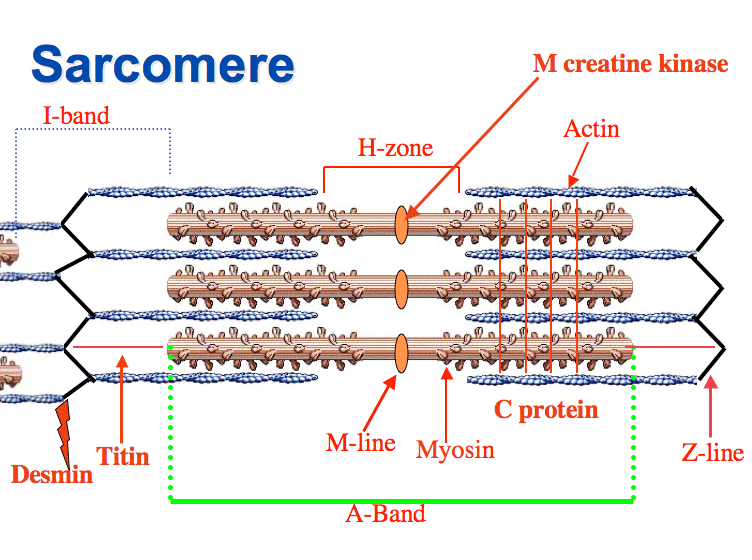
Oh man look at that sarcomere! Isn't it a beauty?
Muscles are the part that I don't get though. If anyone has any ideas about muscle studying please share.
Subscribe to:
Posts (Atom)


 Call Me Kris visitors